
Here’s the thing, most people don’t wake up one day and consciously decide to build a life that exhausts them.
Nobody sits there as a kid thinking, “You know what I’d love? To spend the next few decades chasing approval, ignoring my instincts, calling burnout ambition, and pretending I’m fine because it makes other people more comfortable.”
That would be weird because usually, it happens behind the scenes, quietly.
You follow the rules because that’s what everyone tells you to do. Be good. Be realistic. Be responsible. Get the grades. Get the job. Get the credentials. Build the résumé. Don’t ask too many questions. Don’t be too intense. Don’t make things awkward. Don’t rock the boat. Don’t say the thing everyone is thinking unless someone with more authority says it first.
At first, it feels like wisdom. Sort of a preservation method.
Then, over time, it starts to feel like wearing someone else’s shoes…
You can still walk, technically. You can still get things done. You can still show up, smile, perform, produce, and tell people you’re “good” when they ask how you are.
But something feels off. There’s a pinch somewhere. A quiet pressure. A tension in your chest when you say yes but mean no. A heaviness when you open your laptop. A weird anger that shows up at random moments and makes you wonder if you’re becoming a bitter person, or if some deeper part of you is finally tired of being ignored.
You may look successful on paper and still feel like you’re living at a distance from yourself.
That’s the part most people don’t know how to talk about. Because what do you do when the life you built is “working,” but it doesn’t feel like freedom?
What do you do when you followed the script and still feel trapped?
What do you do when the path that was supposed to make you feel secure just made you exhausted, overthinking, overperforming, and quietly pissed off at the world?
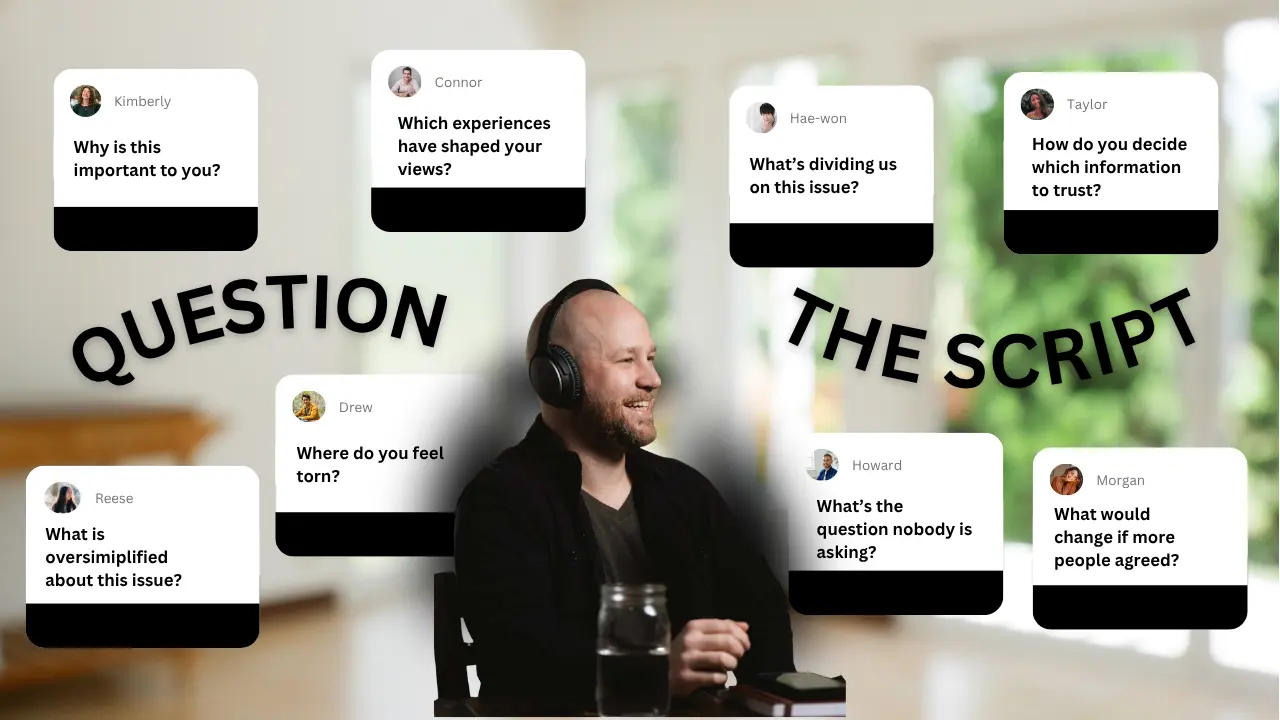
You start asking better questions. That’s where this begins.
I’m not interested in handing you another script. The world has enough of those. There’s a script for success. A script for professionalism. A script for productivity. A script for healing. A script for spirituality. A script for business. A script for how to be masculine, feminine, employable, impressive, marketable, respectable, likable, normal, and “realistic.”
Most of these scripts come dressed as good advice. That’s what makes them so slippery. They sound reasonable. They sound mature. They sound like something a guidance counselor, manager, parent, professor, guru, algorithm, or very confident LinkedIn person would say.
- “Play it safe.”
- “Be grateful.”
- “Stay in your lane.”
- “Don’t burn bridges.”
- “Be professional.”
- “Trust the process.”
- “Don’t question the experts.”
- “Just be consistent.”
- “Follow the proven model.”
- “Do what works.”
Okay – SOMETIMES that advice helps.
Sometimes bridges should stay intact. Sometimes consistency matters. Sometimes expert guidance is valuable. Sometimes the proven model is proven for a reason.
I’m not here to throw a folding chair at every structure in society and call it enlightenment. I’m saying we need to stop accepting every script as truth just because it was handed to us by someone with confidence, credentials, a title, or a clean website.
Think about it this way: If you get into your car and the GPS is set to the wrong destination, following the directions perfectly does not make you wise. It just makes you obedient to the wrong map. You can make every turn correctly and still end up somewhere you never wanted to be.
That’s what happens to a lot of people.
They’re disciplined, capable, smart.
They’re trying, but they’re following directions.
The problem is, they never stopped to ask who entered the destination.
Was it fear?
Family expectations?
Cultural programming?
Old trauma wounds?
Survival mode?
The need to prove something?
The desire to be seen as successful by people who never bothered to ask what success actually means to them?
That question changes the whole game.
Because once you realize the map may not be yours, you can stop blaming yourself for being miserable on the route.
Most people are not broken. They’re running old directions. They’re living from default settings they never consciously chose. They’re operating from beliefs that were installed so early they feel like personality.
And that’s where my work lives.
I call it identity calibration, and it’s basically like architecting a new awareness and way of seeing the world.
That might sound fancy, so let me make it simple to understand. Awareness architecture is the practice of looking at the invisible structures shaping your life:
- The beliefs.
- The fears.
- The assumptions.
- The emotional patterns.
- The inherited definitions of success.
- The stories you tell yourself about money, health, love, work, identity, authority, safety, and what you’re “allowed” to want.
It’s looking at your life like a house and finally asking, “Who designed this floor plan?” Because a lot of people are trying to furnish rooms in houses they don’t actually want to live in.
They change the décor. They buy a new planner. They start a new routine. They listen to another podcast. They create a vision board. They reorganize the pantry as if the real issue is almond flour placement.
And look, I respect a good reset. But if the foundation is cracked, the wallpaper is not the problem.
Awareness architecture asks better questions.
- Why do I keep choosing this?
- Why does this feel safe even though it drains me?
- Why does rest make me feel guilty?
- Why do I trust other people’s opinions more than my own knowing?
- Why do I call fear “being realistic”?
- Why do I keep chasing a version of success that doesn’t even sound like me anymore?
- Why does my body feel like it’s rejecting a life my mind keeps defending?
Those are not small questions. They are the kind of questions that start opening locked rooms. And once you start seeing the rooms, you can’t fully unsee them.
That’s the inconvenient part of awareness. It removes certain excuses.
Before awareness, you can say, “This is just how I am.”
After awareness, the sentence changes.
- “This is a pattern.”
- “This is a script.”
- “This is something I learned.”
- “This protected me once.”
- “This is costing me now.”
That shift matters.
Because “this is just how I am” feels permanent. But, a pattern can be interrupted. A script can be questioned. A structure can be rebuilt.
Let me ask you this.
How many ways can you get to the number 5?
Most people immediately think 2 + 3, maybe 4 + 1.
Simple. Familiar. Obvious.
But you can get there with 10 – 5. You can get there with 1 + 1 + 1 + 1 + 1. You can get there with 25 divided by 5. You can get there with 100 – 95. You can get there in ways that feel clean, complicated, ridiculous, elegant, or completely unnecessary.
∫₀^∞ e⁻ˣ dx + limₓ→₀ [ln(1+x) / x] – e^(iπ) + ∑_{n=1}^∞ (1 / 2ⁿ) + d/dx [sin(x) + x]ₓ₌₀ = 5
Part 1 (Integral): ∫₀^∞ e⁻ˣ dx = 1
Part 2 (Limit): limₓ→₀ [ln(1+x) / x] = 1
Part 3 (Euler’s Identity): -e^(iπ) = 1
Part 4 (Infinite Series): ∑ (1 / 2ⁿ) = 1
Part 5 (Derivative): d/dx [sin(x) + x] at x=0 = 1
Yes that’s a real equation. And even though I don’t understand any of it – the answer is still 5.
Life works more like that than most people realize. We get trained to believe there is one correct equation, one respectable path, one approved timeline, one acceptable definition of success, one “smart” choice, one way to heal, one way to build, one way to lead, one way to be taken seriously.
Then we spend years judging ourselves because our equation doesn’t look like the one everyone else is clapping for.
That’s insane!
There are more ways to get to 5.
There are more ways to build a life.
There are more ways to be successful.
There are more ways to be happy
There are more ways to be useful.
There are more ways to be free.
The problem is, most people are taught to memorize the equation before they are taught how to think.
That is why questioning matters. And yes, I know the word “questioning” makes some people nervous now.
We live in a world where asking questions can get you labeled difficult, negative, rebellious, arrogant, unqualified, unsafe, or my personal favorite, “conspiracy-minded.”
Fine. Let’s talk about that.
I have no interest in becoming the guy who believes every theory just because it sounds forbidden. That’s just another form of lazy thinking. If someone rejects every mainstream idea automatically, they’re still letting the mainstream control their beliefs. They’re just playing the opposite side of the same game.
That’s not discernment. Discernment is slower, cleaner, more honest.
Discernment asks, “What do we actually know?”
- “What are we assuming?”
- “Who benefits if people believe this?”
- “What evidence supports it?”
- “What evidence challenges it?”
- “What incentives are involved?”
- “What emotions are being triggered?”
- “What language is being used to shape interpretation?”
- “What part of me wants this to be true?”
That last question is important, because if we’re going to question the world, we also need to question ourselves.
Otherwise, we just trade one script for another.
That’s where a lot of people lose the plot.
They wake up to one set of lies and immediately move into a different mental neighborhood with worse lighting and louder neighbors. Now everything is a plot. Everyone is a villain. Every institution is evil. Every coincidence is confirmation. Every disagreement is proof that others are asleep.
That’s not freedom.
The goal is not to become a paranoid skeptic. The goal is to become a conscious questioner.
Questioning the script means you’re willing to look underneath the surface. It means you don’t outsource your authority to institutions, influencers, algorithms, experts, gurus, politicians, marketers, pastors, professors, or people with impressive lighting setups.
It also means you don’t outsource your authority to your fear, your trauma, your ego, your anger, or your need to be right.
That’s the grown-up version of questioning. It has teeth, but it also has discipline.
I trust that kind of questioning. But, I’ve had to.
My life didn’t exactly hand me a neat little script and say, “Here you go, Drew. Follow this and everything will make sense.”
Cancer at ten years old pretty much blew that option up.
When you’re a kid and life becomes hospitals, surgery, treatment, fear, uncertainty, and adults trying to be brave in rooms where nobody really knows what to say, you learn early that the official script has limits.
You learn that “everything happens for a reason” can sound real cute when it’s stitched on a pillow and absolutely useless when a child is lying in a hospital bed wondering whether his body will ever feel normal again.
You learn that strength is not always inspirational. Sometimes strength is ugly. Sometimes it’s quiet. Sometimes it’s one more treatment, one more attempt, one more day, one more step when the body doesn’t want to cooperate.
Then my father died during that same season, and whatever childhood script I had left got ripped in half – again.
So no, I don’t trust easy answers. I don’t trust polished formulas that pretend life is simple. I don’t trust success advice that ignores grief, fear, trauma, survival, bodies, money, exhaustion, and the weird ways people learn to protect themselves.
I also don’t trust victimhood as a permanent address. Life can be brutally unfair, but we still have to decide what we’re going to do with what remains.
That tension shaped me and my perspective.
Later, I followed the respectable route. Law school. Bar exam. Professional identity. Then business. Coaching. Marketing. Strategy. Copywriting. Funnels. Offers. Positioning. Messaging. Psychology. Human behavior.
I learned how people make decisions.
I learned how fear works in marketing.
I learned how language moves people.
I learned how stories shape identity.
I learned how businesses can manipulate desire, insecurity, urgency, belonging, and pain.
I learned how many brands are basically emotional pickpockets with better fonts.
And I learned something about myself too…
Marketing was never the whole gift. It was one place the gift showed up.
The deeper gift was pattern recognition. I could hear what people were saying underneath the words. I could see when a strategy problem was really an identity problem. I could see when a business owner didn’t need more tactics. They needed to stop hiding behind tactics. I could see when someone’s brand was built around a version of themselves that was created for approval instead of truth. I could see when ambition was clean and when it was just an old wound wearing a nice watch.
That’s the work I care about now – the pattern underneath the pattern – because the pattern is where the power is.
If you only change the surface, the old script keeps running in the background.
It’s like changing your phone case when the operating system is full of glitches. Sure, it looks better. Maybe it even feels new for three days. But then the same problems show up because the deeper code never changed.
A lot of personal development works that way.
- New routine. Same identity.
- New goal. Same fear.
- New business. Same approval wound.
- New relationship. Same boundary pattern.
- New planner. Same avoidance.
- New vocabulary. Same cage.
At some point, you have to stop decorating the cage and start looking for the door.
That line matters to me.
I’ve decorated plenty of cages.
Achievement can be a cage.
Professionalism can be a cage.
Respectability can be a cage.
Being “the strong one” can be a cage.
Being the person who always figures it out can be a cage.
Even personal development can become a cage if it turns into another way to constantly fix yourself instead of finally trusting yourself.
That’s why this brand, this work, this next chapter matters to me.
I’m tired of safe. Safe got me burned out. Safe made me palatable. Safe helped me explain myself in ways other people could digest quickly. Safe kept me from saying the sharper thing because I didn’t want to be judged, misunderstood, dismissed, or labeled.
The funny thing is, safe didn’t even work, and that’s the part that annoys me most.
I did the “acceptable” version. The safe, strategic version. The watered-down version. The version that tried to make all the parts of me fit inside clean little boxes.
Broker. Lawyer. Business coach. Marketing strategist. Mindset guy. Copywriter. Consultant.
All technically true, but none of them felt complete.
It’s like trying to describe a lightning storm as “weather.” Technically accurate, but not enough to really tell you anything
The deeper truth is that I am a questioner, an observer, a perspective generator, an awareness architect.
I notice the script. Then I poke it.
Sometimes gently. Sometimes with a big stick. Sometimes with the emotional equivalent of a sledgehammer because the thing has had too much power for too long.
That is the work.
- Question the script.
- Find the pattern.
- Reclaim authority.
- Lead yourself from truth.
This applies everywhere.
Business. Health. Money. Relationships. Spirituality. AI. Education. Media. Leadership. Success. Marketing. Identity. Fear. Faith. Family. The body. The nervous system. The stories we inherit and then defend like we wrote them ourselves.
I want to question all of it.
- Why do we call burnout ambition?
- Why do we call obedience maturity?
- Why do we call fear wisdom?
- Why do we call manipulation marketing?
- Why do we call conformity professionalism?
- Why do we teach kids to memorize answers before we teach them how to question premises?
- Why do we train people to be employable before we teach them to be self-led?
- Why do we treat the body like an inconvenience until it breaks?
- Why do we chase success before asking whether we even want the life attached to it?
- Why do we hand our attention to algorithms and then wonder why our thoughts feel like a junk drawer during an earthquake?
These are not random questions.
They all point back to the same thing -> Who is leading your life – you or the script?
That question is uncomfortable because it removes some hiding places.
If the script is leading, you can blame the script forever. And listen, some scripts deserve blame. Some systems are broken. Some institutions are corrupt. Some cultural norms are insane. Some incentives are ugly. Some people in power absolutely benefit from keeping others confused, dependent, distracted, divided, or afraid.
We should talk about that. We should question that. We should not pretend the world is neutral.
But if every problem stays “out there,” nothing changes in here. And “in here” is where your next choice lives.
That’s why self-leadership matters.
Self-leadership is not a cute concept to put on a coffee mug. It is the difference between living consciously and being dragged around by old programming with a calendar full of obligations.
Self-leadership means you start telling yourself the truth. You notice when fear is driving. You catch the pattern before it runs the whole day. You stop confusing familiar pain with safety. You learn to pause before handing your power to someone else’s opinion. You build confidence through evidence. You stop calling every old survival response your personality. You ask what your body is trying to tell you. You define success in a way your actual life can survive. You stop waiting for permission from people who are still following maps they never questioned.
None of this requires perfection. Thank God, because perfection is just another script with better shoes.
This is about practice. A small daily return. A willingness to ask, “What is true here?”
Then, “What does that truth ask of me?”
That second question is where things get real because awareness without action can become another hiding place.
I know because I’m good at awareness – Gemini brain. INTJ pattern mapping. Projector observation. My whole internal committee loves a good analysis. Give me a pattern and I will mentally turn it around like a Rubik’s cube until it confesses.
But insight alone doesn’t change a life. You have to do something with what you see. That’s where the practical work comes in.
- A cleaner boundary.
- A braver conversation.
- A body-supporting choice.
- A decision to stop chasing the version of success that keeps making you resentful.
- A willingness to say, “This is no longer mine,” even if the old identity is still sitting in the room looking offended.
That’s how you start. Not by blowing everything up. Sometimes the most rebellious thing you can do is make one honest choice. That may sound too simple, but simple doesn’t mean small.
Think of a rocket launch. Move the track one degree at the start, and it may not look like much. But miles down the line, that one inch becomes a completely different destination.
That is how self-leadership works. One honest choice changes the angle. Then another. Then another. Eventually, you’re not living the same life anymore.
All because you finally stopped abandoning the person you already were underneath the programming.
That’s the heart of this manifesto.
I am done abandoning that version of myself.
The sharper version. The weirder version. The questioner. The observer. The person who sees patterns and says, “Wait a second. Why are we all acting like this is normal?” The person who has lived through enough fire to know that playing the acceptable role will not save you. The person who understands marketing but refuses to reduce human beings to conversion points. The person who believes spirituality should make us more honest, not more vague. The person who believes mindset work should include the body. The person who believes success without self-trust is just a shinier form of dependence.
The person who believes questioning is sacred when it is done with courage, humility, and enough groundedness to avoid turning every shadow into a monster.
This is the direction now.
More questions.
More analogies that make people say, “Damn, that’s exactly it.”
More conversations about the things people feel but struggle to articulate.
More calling out scripts that have been running the show for too long.
Less sanding down. Less explaining the edge away. Less pretending that “marketable” is the same thing as meaningful.
I know some people will still judge it.
Good! People judged the old version too.
That’s the hilarious scam of playing safe. You shrink yourself to avoid judgment, then people judge the smaller version anyway.
So you might as well be judged for telling the truth. At least then your life is honest.
This does not mean becoming reckless with language or careless with claims. Words matter. Truth matters. Evidence matters. Nuance matters. If anything, this direction requires more responsibility, because strong questions can wake people up or make them more afraid.
I’m not here to make people more afraid. There’s enough fear being sold already.
I’m here to help people think.To pause. To notice. To question. To come back to themselves. To stop treating their own inner knowing like an unreliable witness while handing the microphone to everyone else.
This is the invitation.
- Question the script.
- Ask who wrote it.
- Ask whether it still fits.
- Ask whether your body believes the story your mouth keeps telling.
- Ask whether the success you’re chasing is yours.
- Ask whether your fear is giving you wisdom or just trying to keep the old cage intact.
- Ask whether your anger is destruction or trapped life force asking for direction.
- Ask whether the thing you call “too much” is actually the part of you that needs to be set free.
Question the script, then take one honest step. That’s where freedom starts.
The door is there. Stop decorating the cage and step out.