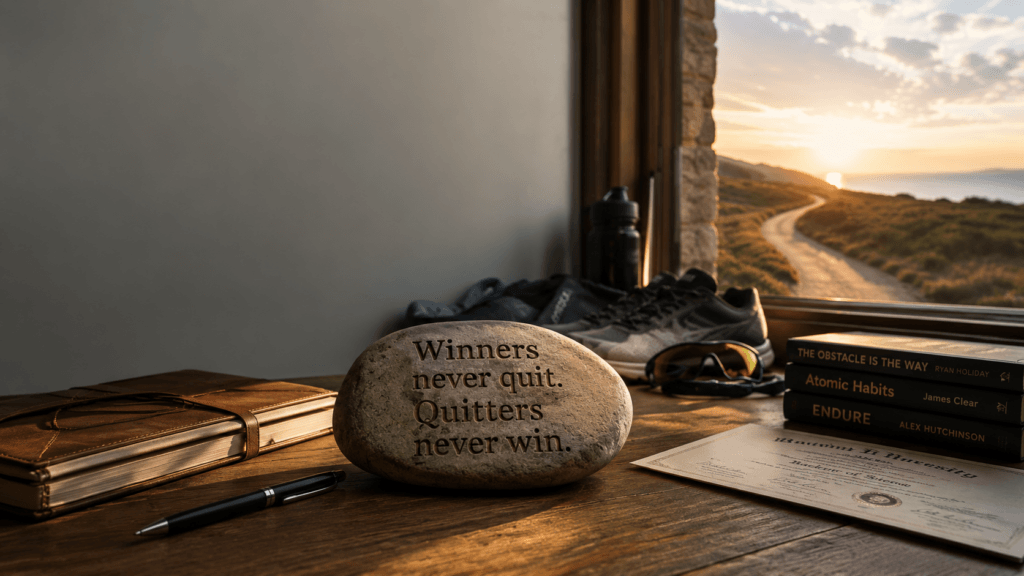
Resilience is a skill. There is a stone on my desk engraved with six words: “Winners never quit. Quitters never win.“ To someone else, it might look like any other motivational quote. Something you would see on a gym wall, a locker room poster, or the kind of desktop decoration people buy when they are trying to convince themselves to answer emails with a better attitude. But to me, it’s a reminder. And it’s tied to a thread that runs through almost every major chapter of my life. Those words were given to me by my father when I was 10 years old, during a season when I needed armor more than I needed encouragement. The Shirt My Dad Made For Me When I was 10, I was diagnosed with Ewing’s Sarcoma. The tumor was around L5-S1, near the base of my spine. Treatment meant a 19-hour surgery, chemotherapy, radiation, months in bed, time in a wheelchair, lasting nerve damage in my left leg and foot, and eventually learning how to walk again. No child is supposed to understand words like oncology, chemo, radiation, or survival odds. No child is supposed to have their world shrink down to hospital rooms, medical equipment, physical pain, and adults trying to sound calm when you can feel the fear underneath their voices. But life does not always ask your age before it tests you. During my treatment, my dad made me a shirt that said: Winners never quit (on the front), and Quitters never win (on the back). At the time, I did not have the wisdom or vocabulary that I have now. I was not thinking about resilience as a philosophy. I was not thinking about identity, emotional authority, self-leadership, nervous system regulation, or any of the things I can explain much better now that I am an adult. I was just a kid trying to survive something no kid should have to go through. But even then, I was aware of the mindset. I understood, at least in the way a 10-year-old can understand, that what I believed mattered, my attitude mattered, and that giving up internally was not an option. The shirt was not just a shirt. It was a message from my father. It was a reminder of who I was supposed to be when things got hard. Six months into my treatment, just under the halfway point, my dad passed away, and that changed the story forever. Because now the person who gave me the phrase was gone. But the phrase and the ideology behind it stayed. Living It Before I Understood It I think some lessons enter your life before you are old enough to fully understand them. At 10, I could wear the shirt. I could repeat the words. I could try to be tough like John Wayne or Rocky. I could keep showing up for treatment, recovery, physical therapy, and whatever came next. But I could not fully understand what was being built in me. That came later. It came through reflection, life experience, and the process of getting knocked down in other ways and realizing that the same message kept rising up inside me: Find a way. Then, if there is no obvious way: Make one. Looking back, I can see that I was developing an operating system, not just surviving cancer. It’s not that I never struggled, never broke down, never got angry, never felt grief, or never questioned why things happened the way they did. Because of course I did. But somewhere inside that experience, a pattern was planted: When the path disappears, you do not collapse and call that the end of the story. You look for another path, and if you cannot find one, you make one. The Motto Kept Showing Up That motto did not stay in childhood; it kept following me. Or maybe I kept carrying it. It was there when I had to learn how to walk again. Slowly. Awkwardly. Frustratingly. I had none of that inspirational movie montage that people imagine when they talk about comebacks. It was there when I dealt with the lasting nerve damage in my left leg and foot. The kind of limitation that does not go away just because you are motivated. The kind you have to adapt to, work around, and live with. It was there when I competed in triathlons. Because apparently, surviving cancer was not enough. I also needed to voluntarily sign up for swimming, biking, and running like some kind of overachieving lunatic with compression shorts. But that was part of the point. I wanted evidence that my body was still mine. That limitation did not get the final vote. That pain and damage could shape the path without owning the destination. It was there when I became a group exercise personal trainer and taught P90X three times per day, six days per week. Three times a day. Six days a week. Not forever, but for two 90-day sessions in a row. That kind of schedule runs on discipline, identity, and a little bit of “what is wrong with me?” energy. But again, the motto was there. Keep going. Find a way. Make one. It was there when I graduated from law school. It was there when I passed the Massachusetts bar exam on my first try. And in 2015, after doing both, I got a tattoo on my left bicep: Aut Viam Inveniam Aut Faciam. Latin for: I will find a way or make one. Different language, same operating system. The shirt was inherited. The tattoo was chosen. That distinction matters to me. My father gave me the first phrase when I needed it most. Years later, I chose to mark the philosophy on my body as my own. Not Every Fire Was Physical Cancer was not the only fire. Some fires were physical.Some were emotional.Some were professional.Some were financial.Some were the kind of fire you choose because you are chasing growth.Some were the kind